Apparently, blogging is an essential aspect of one's studying Foundation Art these days. O blogspot, you are my vitamins...
Unfortunately, having not created this thing prior to starting my course (only 15 days ago, mind) I now have a backlog of things so this first post may be some variant on a marathon.
And so we begin:
with reference to -
Emily Speed - Inhabitant Antony Gormley - Cells


'It becomes a cell, a retreat, a bolt hole; crucially it is an extension of the self.'
Looking at residual traces like time, memory - flesh bone wood; the circumstances that allow something to be preserved like fossils, but also the more mundane usual things like the objects others may think of as trash yet we keep and treasure and construct ourselves from.
I read a book earlier in the year called 'Flesh Bone Wood' which is about 'entering into the mysteries of the cross' and 'provides a series of daily spiritual exercises from Ash Wednesday to Easter day based on the Passion of the Christ, inviting us to witness in our imaginations the final events of Jesus' life, his crucifixion, and death, and the wonder of the empty tomb'. I feel I must state that I am resolutely NOT a christian but found it interesting none the less, if only for the strange pagan transubstantiation of Christ for the wounds and the blood like a perverse metaphysical semi-permeable membrane allowing all sin and evil to be absorbed into its contorted hoary bones. I kind of like this hallowed cellular tomb-ish idea; the simplicity of the similarities between bone, wood and flesh.
Bone / Cardboard:
When looking at Emily Speed's constructions I am reminded of the flesh/bone/wood aphorism, of Sylvia Plath's haunting poem wherein she is haunted by a vision of herself trapped in the glass/lake as a repugnant old crone who swims towards her as a fish who is as repugnant as it is inescapable, and also a more benign kind of image - those of Gormley's tea-stain like cells and files of little people, all different, all the same, everything trapped in boxes like the meaning of meaning of meaning...
I should
probably discuss and display the work I have been doing (and I have been doing a lot of it) but I feel I need to adequately explain some concepts and views behind things - as tedious and pretentious as I may be ;)
I like the idea of things being made of trash very much. Last year, I suffered a major attack of DADA and the use of cardboard and bus tickets and the disposability of the final object impressed me greatly. I suppose as much as when you first see Duchamps' urinal on a plinth and laugh and then really think - what DOES define an object as a work of art? ... Anyhow. I like the tactile everyday nature of rubbish. It's like the kind of TV or music or clothes somebody might wear - what somebody would frame as art and others as absolutely nothing. I love Schwitters' 'Merzbau'. It's a fortified delight :)

As a group, we made vaguely Emily Speed constructions which was food for thought in terms of construction and how we interpret the spaces around us and, fundamentally, how we construct them/our view of reality from the world around us. I think I have already mentioned this BUT it really does make me ponder upon all the little things we think are important in our very lovely subjective ways and the way we treat them - like the magical, protective, psycho-active powers of crystals, the spirits of stones and wind and things.

I collected marks made from rubbing the shells of... well... shells, and dipping them in ink and rolling them around some paper pretending I was the ocean (fun, muchos fun). I was surprised when I took a hammer to them that some were shattered completely but some remained intact no matter how hard I bashed them. I enjoy their individual differences :3 I also thought a little on the patterns on shells and their fractal nature - then I collected some leaves and made a twee little picture of a leaf skeleton as a little tree...

As a class, we took a trip to Tate Liverpool and one piece in particular struck me: an enormous table and chair set by Robert Therrien in an otherwise empty room. The size made it seem very alien, absurd and oppressive. It made me feel rather a sombre and minute being, like being lost in a witches/giants house. It made me think of the strange symbolism of dolls' houses and dioramas. And, also, of Freud's list of irrational fears (confusions of reality and imagination, inanimate objects seeming animate and vice versa and the rest...)
BELOW: in my sketchbook I twinned two of my emergent themes with images I happened across within my own personal books. One is of an exquisite little Victorian Dolls' house and the other is a diagram of some age, showing the interior functions of the mind as little dolls house type rooms with industrious little doll-like men at work in their little brain-room-offices. I love this for its simplicity - it combines many aspects of nearly everything I have thought about so far. And it's an adorable, subversive dolly house. Brilliant! Anyhow, onwards and upwards etcetc.
BACK in class, we did some degree of work on automatic drawing and I collected incidental marks and the like, but for the time being these are not important because ...


I got to thinking more on the miniature, fractals and sameness - on casements and shells and everything I said before. Being in the strangely insidious Therrien piece, I recalled Schwitters' 'balancing sense against nonsense'. That is to say, the strange quasi-ironic duality of some things. Like the innocent / sexual nature of some things. The japanese goth-loli attempt to
recapture an air of youth and innocence and the like (as long as you're not ero-loli or gore I guess) - all manner of things that never were and will never actually be - somewhat like people endowing bits of rock with great therapeutic and/or prophetic qualities. It also, less amusingly, throws up thoughts of Courtney Love (<3) and her child/doll like aesthete of the 90s and her consistent reference in songs to witches, angels and children's characters (eg - 'I don't really miss god but I sure miss Santa Claus'). Mostly, however, I love and thought about Courtney's (<3) use of dolls and infantile fantasy as an expression of her inward desire for all of those twee never-were things, the happiness, innocence etc, and the perverted reality of these things that she lives in. ('i want to see you stretched out on the floor, the world's broken doll, the world's shattered whore. and you, you can't walk but you, you can crawl...)

Below: part of sketchbook page concerning Courtney Love and dolls / doll parts / poppets / voodoo (including a still from the Doll Parts music video)
Below: continuing this stream, stills from Simon Armitage's 'Pendle Witch Child' documentary - the sallow figure dropping the accursed clay figurine
Below: work on dolls, doll forms.
Strange, simplified bodies.
Below: small articulated figure based on Man Ray's coat stand (also below)
Man Ray's coat stand is an important image for me. Since I first saw it at the beginning of my DADA-rama thing, it's had peculiar, stark, lingering resonance. Like an echo I suppose, or an unpleasant intrusive thought. It fits so neatly in with my doll/figure fixation. Of it, Man Ray said: 'there is a close fusion between the female body and a doll-like construction. The two unite to form a new being.'
With reference to this (and all other things discussed thus far) I began to seriously think about the simplification of the human form (as seen in above doll studies) and also it's representation in the arts.
I love 'incidental marks', boot prints, paint splashes and the like, because they are so simple - but seem to have a narrative all their own. And I think this feeds heavily into my trash / merzbau love of rubbish-cum-art in all it's Duchamp-is glory. I love how small artifacts and loose ends and seemingly insignificant things all come together like a magic eye picture to show you the whole - looking in such a way you can see the whole world! It's like the difference between knowing something and actually understanding it. Like... I know that e = mc squared but I don't actually understand for a second what that means. Something about relativity. I don't know. Shame on me :( But anyway - It's like the idents for channel four that line up and suddenly the abstract nonsense becomes a 4! Seeing all of this, it makes sense that I love collage and how the human eye in all its evolutionary splendour make those amorphous coloured blobs come together to make an image, a symbol of something.
Below: Matisse collage to make a woman. And an image from my sketchbook - a collage after a photograph by Andy Warhol of a man posing as a statue.
Speaking of Andy Warhol's images - I love his drawing. They're simple, almost childish, but have a strange intellectual kind of elegance about them. I see them as being like a refined / more minimal Quentin Blake thing. But I suppose pen and ink will always look reminiscent of pen and ink... if Warhol even drew in pen and ink.
Warhol:
Pale imitation:
As I said, I was looking into the simplification of the human form, such as when we decide who someone is when we deny them actuality and they become the pantomime dame or witch or whatever and we refuse them the ability to move beyond those things - such as Man Ray's 'Coat Stand' who is, in fact, a lady behind there, but now she's on her Duchamp-y plinth she isn't a woman, she is a coat stand because that's what the artist has decided she is. He's boxed her in, like Emily Speed peeking out of her 'inhabitant' piece.
// I'm actually exhausted now and have somewhere to be. I'll get to the point sooner or later. I promise. And it won't all be a mad rush to ram everything in here.
X


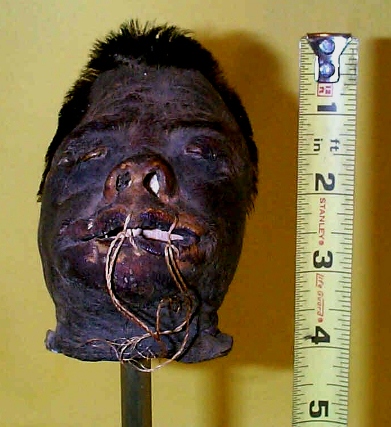 With a gallant and exquisite return to the magical doll/fetish theme of yester-post, shrunken heads! I believe on QI they once mentioned them briefly, and said you knew when you had a fake head because the stitching was too neat, too perfect, and the real thing was hewn together by mad head hunting tribe people - mad in that they stole the skin of some poor murdered persons face and made it into a trinket. (Weirdly, though I'm rather squeamish and necrophobic, oddities like shrunken heads don't actually bother me that much. They're such an abstraction on death and the culture I live in I feel more curious than disturbed. More like a normal person....) ANYHOW, I digress as always. This has to do with the construction of magical items and dolls and humanoid ephemera. A poppet / voodoo doll looks all the more insidious if it is dirty and roughly sewn, crude and primitive instead of looking polished and factory produced - things tend not to look magical with 'made in china' printed on the reverse.


 Thoughts on illustrative materials to build context / narrative, texture, emotion, response... the use of fabric and filling to create potent primitive-like magic feel; the combined and cohesive use of material and method to create a separate entity / piece.
 I thought about the use of these things - in the literal, real, not-metaphysical world. The wrapping of John Claude and Christo that, strangely, reminded me of a story I read about a Vietnamese guy called Le Van who encased his deceased wife's remains in plaster (or similar) and slept with her and kept her as though she were still alive but paralysed. Like Egyptian mummies (too dead to want to google, eugh) the binding, wrapping and encasing of things (like my shells from before) the presentation of the dead - Le Van's dolly wife. She's not bone in plaster, she's his dolly wife. It's a kind of funny but poignant, tragic comedy, of human transience and the need to keep things, section them off as eternal and forever. Because we feel so strongly, because we see those things how we see them, surely it must be so! How far will you believe your own illusions? Ah- 'til we reach the very summit...


